
- The Emergence of Crayfish Aquaculture in the Philippine Market
- Phase 1: Pre-Operational Feasibility and Due Diligence
- Phase 2: Infrastructure and Technical Setup for Scaling
- Phase 3: Optimizing Farming Practices for Maximum Yield
- Phase 4: Strategic Agribusiness Management and Financial Oversight
- Phase 5: Building a Robust Supply Chain and Logistics Network
- Phase 6: Modern Marketing Strategies for the Filipino Farmer
- Digital Tools and AgTech Integration for Scalability
- Konklusyon
The aquaculture sector in the Philippines is undergoing a quiet revolution. While tilapia and bangus have long dominated the industry, market saturation and tightening margins are prompting forward-thinking entrepreneurs to look toward high-value alternatives. Freshwater crayfish, often synonymous with premium ulang or imported varieties, represent a significant opportunity for local growers. This guide explores how to transform a basic farm into a professional, profitable agribusiness by bridging the gap between biological production and modern market demands.
The Emergence of Crayfish Aquaculture in the Philippine Market
Identifying the Market Gap and Global Demand for Freshwater Crustaceans
The Filipino palate is evolving. As urban centers like Metro Manila and Cebu see an influx of international culinary trends, the demand for high-quality, sustainably sourced crustaceans has spiked. Unlike traditional species, crayfish offer a firm texture and a versatile flavor profile that appeals to both high-end restaurants and growing retail segments. By identifying this gap, you are not merely starting a farm; you are addressing a clear customer need for premium, locally available seafood that bypasses the volatility of the frozen import market.
The Value Proposition: Why Crayfish Beats Traditional Tilapia or Bangus Models
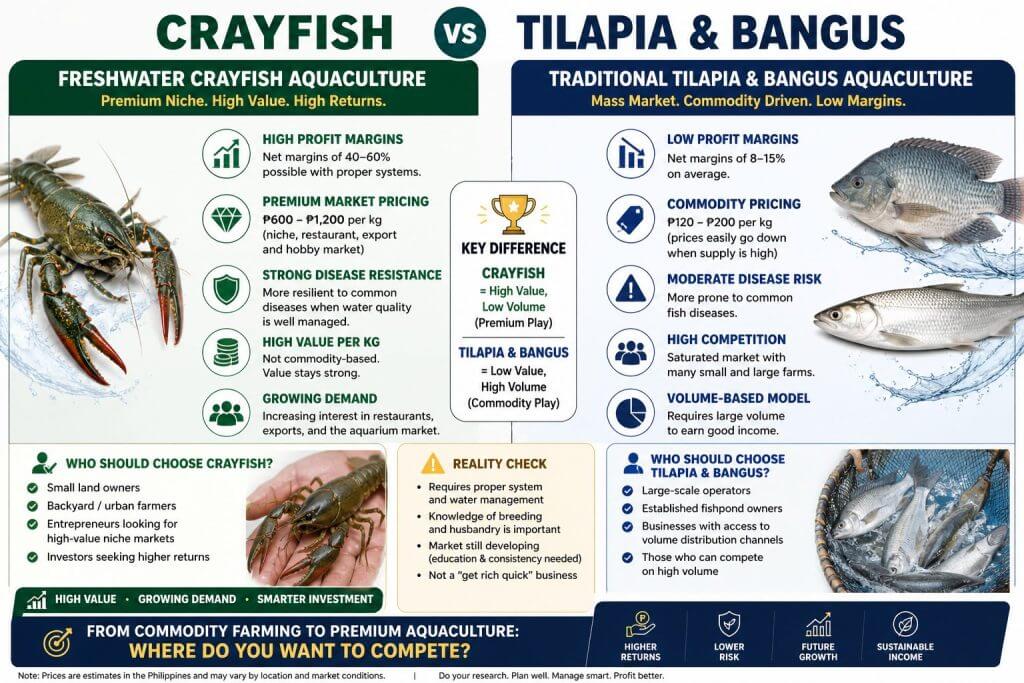
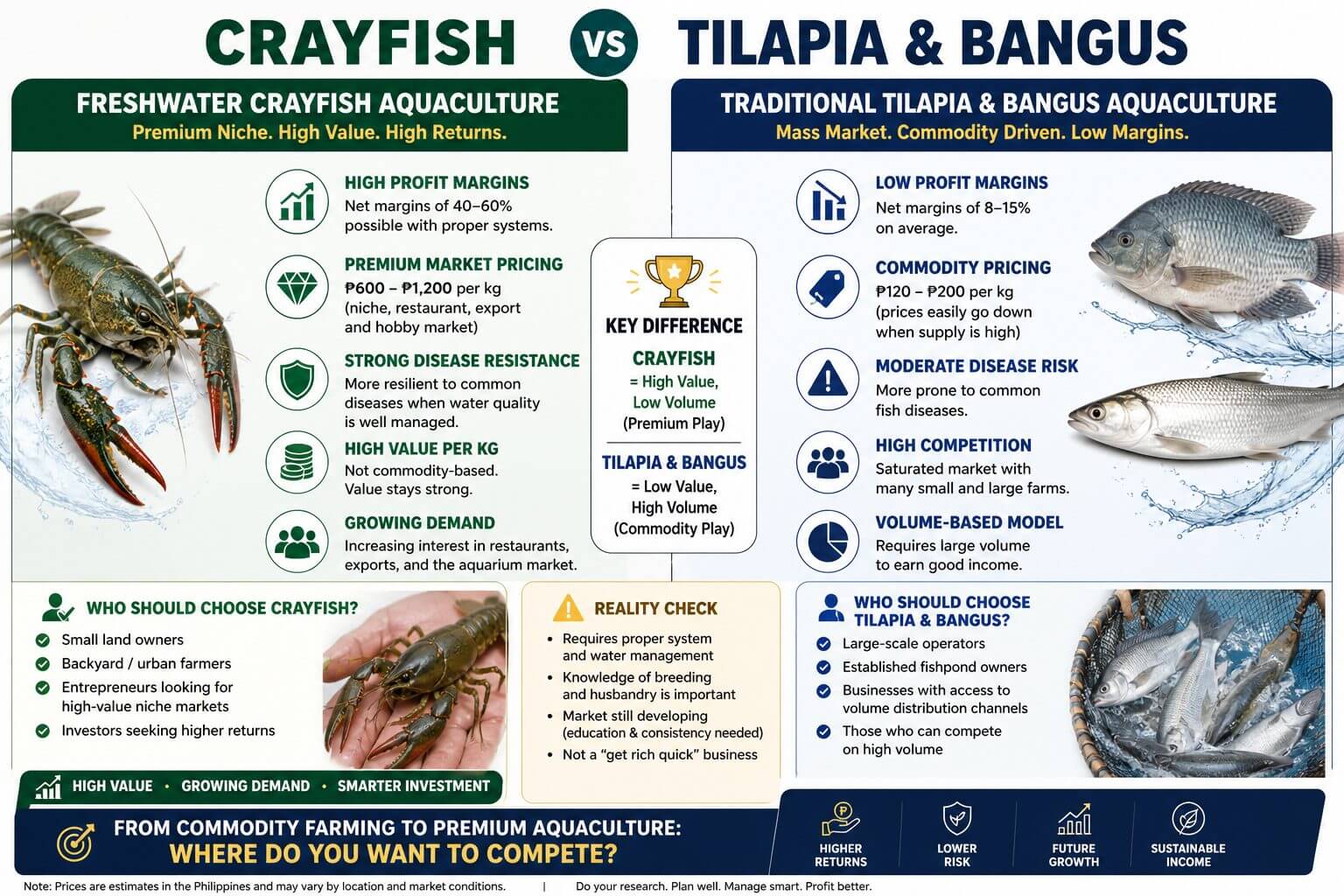
Comparing the agribusiness potential: Crayfish offer higher margins, premium pricing, and better resilience compared to traditional commodity fish.
The primary problem with commodity fish farming is price sensitivity and low profit margins. Crayfish operate in a different tier. Because they are considered a specialty product, they command higher price points. When you treat your venture as a serious agribusiness, you leverage the crayfish’s resilience and fast growth cycle. Unlike fragile, highly prone-to-disease fish species, crayfish can be scaled more efficiently with the right technical approach, allowing for a more predictable return on investment for the discerning owner.
Addressing Food Security through Localized Production
Localization is the bedrock of future food security. By producing crayfish domestically, you reduce reliance on imported seafood, lower the carbon footprint associated with long-haul logistics, and support regional agriculture. This localized supply chain is not just a moral win; it is a tactical advantage that insulates your operation from international supply chain disruptions, ensuring consistent availability for your target customer base.
Phase 1: Pre-Operational Feasibility and Due Diligence
Conducting Market Research on Local Consumption Patterns
Before digging a single pond, you must conduct thorough due diligence. Engage with local wet markets, restaurant chefs, and wholesale buyers to understand specific customer needs. Are they looking for live, fresh-chilled, or processed tails? Gather this information to refine your marketing strategy early. A business that fails to align with consumer demand is destined to struggle, regardless of how successful the farming practices are.
Site Selection: Analyzing Soil Health and Water Quality for Pond Sustainability
Your site is your most critical asset. Beyond land availability, you must conduct soil health analytics. Clay-based soils are preferred for water retention, while consistent access to high-quality, non-polluted water is non-negotiable. Poor site selection is a common point of failure; ensure your water source is free from industrial runoff, as crayfish are sensitive to environmental toxins. Sustainability in farming begins with respecting the local ecosystem.
Navigating BFAR Regulations and Securing Necessary Permits
Compliance is not an obstacle; it is your shield. Working with the Bureau of Fisheries and Aquatic Resources (BFAR) to secure the necessary permits ensures that your agribusiness is recognized and protected. Adhering to government standards for aquaculture is a hallmark of a professional operation and is essential for long-term scalability.
Phase 2: Infrastructure and Technical Setup for Scaling
Designing High-Density Grow-out Ponds vs. Natural Earthen Ponds
Scaling requires a choice between natural earthen ponds, which provide a more “organic” environment, and high-density grow-out systems that utilize vertical space and intensive management. High-density setups require more upfront capital but offer higher yields per square meter. A balanced approach often involves starting with well-managed earthen ponds before transitioning to intensive setups as your team gains experience.
Water Management Systems: Filtration, Aeration, and Recirculation
Water quality is the lifeblood of your farm. Advanced filtration systems, consistent aeration, and, where possible, recirculation technology are required to maintain high densities. These technical investments are part of your core infrastructure, designed to prevent disease and promote rapid growth. Your farm’s technical setup is the foundation upon which all future profitability rests.
The Hatchery Advantage: Securing Your Own Supply of Juveniles
Buying juveniles from external suppliers introduces unnecessary risk. By developing an in-house hatchery, you gain control over the quality, age, and health of your stock. This vertical integration is a hallmark of sophisticated agribusinesses, ensuring that your production cycle remains continuous and your team is never left waiting for external shipments.
Phase 3: Optimizing Farming Practices for Maximum Yield
Selecting Quality Agricultural Inputs: Nutritional Requirements and Feed Conversion Ratios (FCR)
Feed is your largest operational expense. Investing in high-quality feeds that optimize your FCR—the amount of feed required to gain a unit of body weight—is vital. Effective farming practices involve constant monitoring of nutritional intake, ensuring that your inputs support rapid growth without unnecessary waste.
Implementing Lean Management to Reduce Operational Waste
Apply lean management principles to your daily operations. This means optimizing your labor, monitoring energy usage, and reducing material waste wherever possible. When every member of your team understands how small inefficiencies impact the bottom line, your farm becomes significantly more agile.
Soil Health Analytics and Preventive Disease Management
Sustainability is directly linked to disease prevention. By regularly testing soil health and water chemistry, you catch imbalances before they trigger a massive die-off. Preventive management is always cheaper and more effective than reactive crisis management. A healthy, balanced environment is your best defense against biological risk.
Phase 4: Strategic Agribusiness Management and Financial Oversight
Investment Decision Making: Capex for Scaling vs. Opex for Maintenance
Distinguishing between capital expenditure (Capex) and operating expenditure (Opex) is vital. Capex is for your infrastructure—ponds, aeration systems, and hatchery tech. Opex is for your ongoing needs—feed, labor, and energy. Successful managers maintain a disciplined budget, ensuring that they do not overextend on new construction while neglecting the daily maintenance required to keep current operations profitable.
Risk Management: Mitigating the Impact of Climate Change and Typhoons
The Philippines is prone to extreme weather, making risk management a pillar of your strategy. This includes building reinforced embankments, having backup power for aeration systems during outages, and maintaining insurance or emergency cash reserves. A prepared farmer is one who survives the monsoon season, while an unprepared one is left to restart from scratch.
Using Key Performance Indicators (KPIs) to Track Survival and Growth Rates
If you cannot measure it, you cannot improve it. Track your survival rates, average daily gain, and feed conversion ratios religiously. Use these KPIs to make data-backed decisions. This professional approach to farming converts a traditional “labor of love” into a predictable, scalable enterprise.
Phase 5: Building a Robust Supply Chain and Logistics Network
Supply Chain Optimization: Minimizing Mortality During Post-Harvest Transport
The transition from water to market is the “danger zone” for mortality. Use specialized, aerated transport tanks and temperature-controlled storage to move your harvest safely. Every percentage point of survival you preserve during transport is pure profit added to your bottom line.
Cold Chain Requirements and Logistics for Metro Manila and Cebu Markets
To reach premium buyers in major urban hubs, you must bridge the logistics gap. A robust cold chain—maintaining the product at consistent, low temperatures from harvest to the customer’s door—is essential for quality assurance. Without this, your competitive edge in flavor and texture is lost before the product is even sold.
Traceability and Transparency: Preparing for Institutional Buyers
Institutional buyers, such as high-end hotels and supermarket chains, demand transparency. They want to know the origin of the product and the farming practices used. By implementing a traceability system, you open the door to these lucrative, long-term contracts.
Phase 6: Modern Marketing Strategies for the Filipino Farmer
Creating a Go-to-Market Strategy: Direct-to-Consumer vs. Wholesale
Decide early whether you want to focus on high-volume, low-margin wholesale or low-volume, high-margin direct-to-consumer sales. A blended strategy often works best, using social media to build a brand for direct sales while maintaining a steady wholesale anchor to guarantee consistent cash flow.
Utilizing Social Media: Leveraging Facebook and WhatsApp for Hyper-Local Sales
For the Filipino farmer, digital tools like Facebook and WhatsApp are not just social networks; they are powerful sales platforms. Use them to manage orders, provide customer support, and build a local community. These digital tools allow you to bypass intermediaries and engage directly with your market.
Brand Aesthetics and Content Marketing for Premium “Farm-to-Table” Positioning
Content is your most powerful marketing lever. Use high-quality photography and video to tell the story of your farm. Position your crayfish as a local, sustainable, and premium product. A strong brand aesthetic that emphasizes “farm-to-table” quality creates a value perception that justifies premium pricing.
Digital Tools and AgTech Integration for Scalability
To thrive, you do not need expensive software. Use accessible digital tools like Google Sheets for inventory tracking, basic mobile applications for financial record-keeping, and weather apps for climate monitoring. These simple integrations allow you to maintain professional oversight over your agribusiness. By moving away from pen-and-paper to digital, you gain the ability to analyze your growth, spot trends, and scale your operations with precision.
Konklusyon
Scaling crayfish farming in the Philippines is an ambitious endeavor that requires more than just biological knowledge—it demands the mindset of an entrepreneur. By conducting thorough due diligence, prioritizing water quality, mastering the logistics of the supply chain, and embracing modern marketing, you can transform a niche aquaculture project into a robust, sustainable agribusiness.
The opportunities for growth are significant for those who treat their farm as a business first. Remember that your greatest assets are your data, your team, and your commitment to meeting customer needs. Start by optimizing your internal processes, adopt simple digital tools to track your success, and remain vigilant in your risk management practices. As you grow, focus on the quality of your output and the transparency of your operations; this is how you build a lasting brand in the competitive Philippine market. With a disciplined approach to your agribusiness, you are not just farming; you are building a resilient, profitable future.